The Constitution in Exile by Andrew P. Napolitano
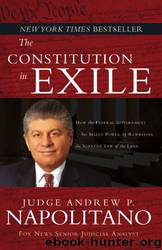
Author:Andrew P. Napolitano
Language: eng
Format: epub
Tags: ebook, book
Publisher: Thomas Nelson
Published: 0101-01-01T00:00:00+00:00
A SOP TO CONGRESS
In NLRB v. Jones & Laughlin Steel Corp. (1937), the Court overruled the limits it had placed on Congress’s commerce power. The National Labor Relations Act of 1935 established the National Labor Relations Board to oversee labor disputes. Congress determined that labor-management disputes were directly related to the f low of interstate commerce and, thus, could be regulated by the federal government. The production-versus-commerce distinction was thus discarded.
In this case, the NLRB charged Jones & Laughlin with violating the act by engaging in unfair labor practices by discriminating against members of the union with regard to hire and tenure of employees, and coercing and intimidating its employees so as to interfere with their organization.
The National Labor Relations Board ordered Jones & Laughlin to cease and desist from such discrimination and coercion and offer reinstatement to all employees that the company had discharged. There were 10 of them; 10 out of 560,000 employees. Could the treatment of the 10 possibly have affected interstate commerce?
The steel industry challenged the power of Congress to establish the Board, and the actions taken by it, as well as the constitutionality of the act itself. The Court upheld the Board’s actions and the constitutionality of the act and ruled that the National Labor Relations Board may regulate those industrial activities, which had the “potential to burden or restrict interstate commerce.”
To quote Ronald Reagan, “There you go again!” The Court stood by while Congress created code words and phrases like “potential to burden” commerce. Doesn’t just about everything fall into that category?
In this decision, the Court’s new majority turned its due process doctrine ruling, as articulated in Lochner and Carter, on its head. And it completely discarded its position that labor relations had only an indirect effect on commerce. (Certainly firing 10 out of 560,000 employees has no direct effect on interstate commerce.) To make matters worse, the same Court that had yet to define the right to work as “fundamental,” and thus entitled to protection from the judiciary, said the right to organize alabor union was “fundamental.”
The Court also said the federal government had the right to intervene in labor disputes. The Supreme Court would now allow Congress to pass legislation that would attempt to equalize bargaining power between employers and their employees. “The exploitation of a class of workers who are in an unequal position with respect to bargaining power and are thus relatively defenseless . . . casts a burden for their support upon the community.” Doesn’t that sound more like Karl Marx than Thomas Jefferson? The justices went so far as to state that the national government was justified in penalizing corporations engaging in interstate commerce which “refuse to confer and negotiate” with their workers as a group. And that is where in the Constitution?
These judicial about-faces were no doubt a reaction to the disastrous economic circumstances of the time and the court-packing stunt much more so than they were true reflections of what is actually a fundamental right under the Constitution.
Download
This site does not store any files on its server. We only index and link to content provided by other sites. Please contact the content providers to delete copyright contents if any and email us, we'll remove relevant links or contents immediately.
| Anthropology | Archaeology |
| Philosophy | Politics & Government |
| Social Sciences | Sociology |
| Women's Studies |
The Secret History by Donna Tartt(18998)
The Social Justice Warrior Handbook by Lisa De Pasquale(12177)
Thirteen Reasons Why by Jay Asher(8874)
This Is How You Lose Her by Junot Diaz(6856)
Weapons of Math Destruction by Cathy O'Neil(6248)
Zero to One by Peter Thiel(5765)
Beartown by Fredrik Backman(5716)
The Myth of the Strong Leader by Archie Brown(5481)
The Fire Next Time by James Baldwin(5409)
How Democracies Die by Steven Levitsky & Daniel Ziblatt(5200)
Promise Me, Dad by Joe Biden(5130)
Stone's Rules by Roger Stone(5065)
A Higher Loyalty: Truth, Lies, and Leadership by James Comey(4937)
100 Deadly Skills by Clint Emerson(4899)
Rise and Kill First by Ronen Bergman(4758)
Secrecy World by Jake Bernstein(4727)
The David Icke Guide to the Global Conspiracy (and how to end it) by David Icke(4684)
The Farm by Tom Rob Smith(4486)
The Doomsday Machine by Daniel Ellsberg(4473)
